ZertES vs eIDAS: What are the key differences for Swiss companies?

ZertES vs eIDAS: legal comparison
At first glance, ZertES and eIDAS look similar. Both define electronic signatures and both recognize qualified electronic signatures as legally equivalent to handwritten signatures.
However, for companies operating in Switzerland, the practical differences are important.
| Criteria | ZertES (Switzerland) | eIDAS (European Union) |
| Legal framework | National law | EU regulation |
| Equivalent to handwritten signature | Yes | Yes |
| Cross-border recognition | Limited | Within EU |
| Use in Switzerland | Compliant | Not always sufficient |
The key difference: recognition and jurisdiction
The main difference between ZertES and eIDAS is where each framework applies.
eIDAS governs electronic signatures in the European Union. ZertES governs electronic signatures in Switzerland.
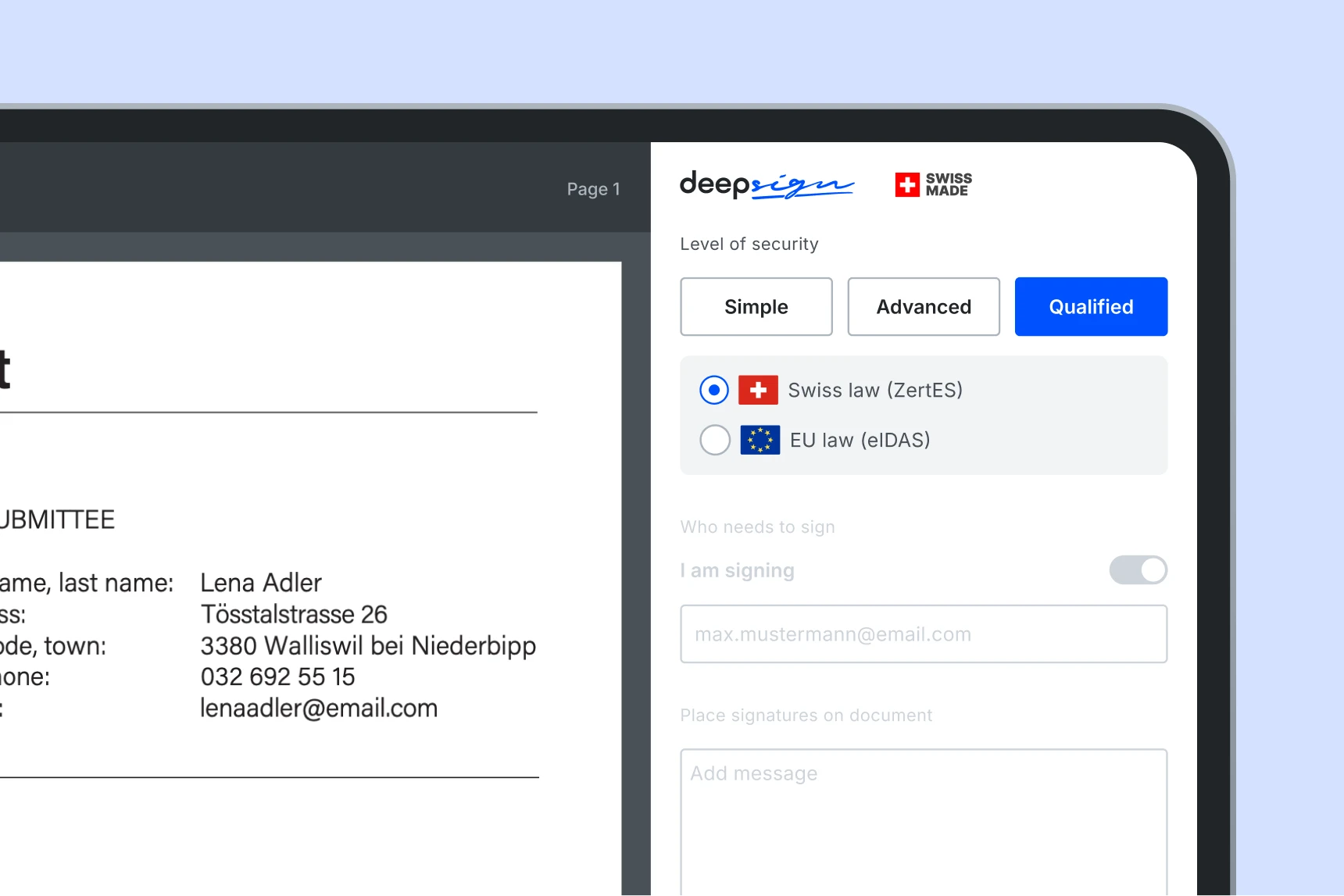
This means that a qualified electronic signature issued under eIDAS is valid within the EU, but it is not automatically recognized as ZertES-compliant under Swiss law.
What this means for Swiss companies
For companies operating in Switzerland, this distinction matters. Using an EU-based electronic signature solution may not be sufficient for Swiss legal requirements.
In practice, Swiss companies should check whether their signature provider supports ZertES-compliant qualified electronic signatures, especially for documents that require strong legal validity in Switzerland.
Common misconception
A frequent misconception is: “If a signature is eIDAS-compliant, it is valid everywhere.”
This is not always true. ZertES and eIDAS are separate legal frameworks. They share similar principles, but they are not interchangeable.
Choosing the right electronic signature framework
For organisations working across Switzerland and the EU, the safest approach is to evaluate the legal requirements of each jurisdiction.
Companies should ensure access to ZertES-compliant qualified electronic signatures when signing documents governed by Swiss law, and eIDAS-compliant signatures when operating under EU requirements.
eIDAS in Switzerland: Is it enough?
If there is one key takeaway from the comparison between ZertES and eIDAS, it is that compliance depends on the jurisdiction in which your documents must be legally recognised.
For Swiss organisations, relying on eIDAS alone may not always be sufficient. Understanding when ZertES applies, and which type of electronic signature is required, is essential to ensure the legal validity of documents governed by Swiss law.
Whether you are signing contracts locally or operating across Switzerland and the EU, having clarity on these requirements helps reduce compliance risks and avoid uncertainty when choosing an electronic signature solution.
If you want a clearer view of the legal requirements, signature types, and available ZertES-compliant solutions, our ZertES practical guide provides a complete starting point for companies looking to implement legally valid electronic signatures in Switzerland.
What if the document has already been signed or sealed?
The distinction between ZertES and eIDAS is also relevant when a company receives a document that has already been electronically signed or sealed and needs to verify its reliability.
In these cases, it is important to determine whether the electronic signature or seal is valid and under which regulatory framework it was issued. DeepValidator verifies qualified electronic signatures and seals according to ZertES and eIDAS, regardless of the provider used. The verification covers aspects such as document integrity, signer authenticity and the validity of the certificate at the time of signing.
For Swiss companies, the verification can also cover signatory authority. Based on official data from the Swiss Commercial Register, DeepValidator can verify whether the person who signed the document has the corresponding authority to sign on behalf of the company.
The distinction between the two frameworks therefore has practical implications throughout the document lifecycle: it helps companies select the appropriate standard when signing or sealing a document and correctly assess and verify electronic signatures and seals received from Swiss or European counterparties.