Digital signature in Switzerland: use and legal validity
Digital transformation is reshaping how organisations and individuals handle documents, agreements and decision-making processes. In this context, digital signatures have become a practical tool to simplify daily tasks, accelerate interactions and ensure a high level of reliability.
In Switzerland, their use is supported by a clear and robust legal framework. Understanding how they work and their legal value enables organisations to adopt them confidently and unlock their full potential.

A new standard for documents and agreements
Signing a document is no longer tied to pen and paper. Today, more and more processes happen digitally, from contract management and internal approvals to interactions with clients and partners.
Electronic signatures are designed to support this shift. They consist of digital data linked to a document, allowing the signer to be identified and their intent to be confirmed.
What changes is not just the format, but the entire way of working: more fluid, more immediate and better suited to dynamic, distributed environments.
The Swiss framework: clarity and trust
One of the most distinctive aspects of the Swiss landscape is its regulatory clarity. The Federal Act on Electronic Signatures, known as ZertES, clearly defines the requirements and conditions for the legal recognition of electronic signatures.
This provides a tangible advantage. Companies and professionals can adopt digital solutions with confidence, knowing exactly when a signature is valid and what level of assurance it offers.
It’s not just about technology, but about a regulated ecosystem that builds trust.
The different types of electronic signatures
There isn’t just one type of digital signature, but several solutions designed to meet different needs.
The simplest is the one most people have already used: typing your name into a document, clicking “I accept”, or attaching a scanned signature. It’s quick and practical, ideal for informal or low-risk situations.
A step up are signatures that include authentication mechanisms and create a stronger link between the signer and the document. This is where elements like one-time codes or secure access come into play, increasing the reliability of the process.
At the highest level is the qualified electronic signature. It is based on digital certificates issued by recognised providers and requires strict identity verification, for example via apps like DeepID or Mobile ID. In Switzerland, this type of signature is legally equivalent to a handwritten one.
A quick overview:
- Simple electronic signature (SES): fast and intuitive, suitable for everyday use
- Advanced electronic signature (AES): stronger control over identity and document integrity
- Qualified electronic signature (QES): highest level of security with full legal validity
| SES Simple electronic signature | AES Advanced electronic signature | QES Qualified electronic signature |
|---|---|---|
| Evidential value Low | Evidential value High | Evidential value Highest |
| Equivalency to handwritten signature No | Equivalency to handwritten signature No | Equivalency to handwritten signature Under Swiss (ZertES) and EU law (eIDAS) the QES is equivalent to a handwritten signature |
| For documents with No statutory form requirement | For documents with No statutory form requirement | For documents with “Written form” requirements |
Legal validity: when a digital signature is binding
Legal validity is a key consideration. In Switzerland, the qualified electronic signature has the same legal standing as a handwritten one. This means it can be used to sign official documents, contracts and any agreements that require written form.
At the same time, other types of electronic signatures are widely used across many operational contexts. The difference lies in the level of assurance required, not in whether they can be used.
In practice, the right choice depends on a few key factors:
- the nature of the document
- the level of legal risk
- the context in which it is used
This flexibility allows organisations to take a pragmatic approach, selecting the most suitable solution case by case.
A practical ally for business efficiency
Beyond regulatory aspects, what makes digital signatures truly valuable is their direct impact on everyday operations.
Take a contract that needs to be signed by several people in different cities. In a traditional setup, the document is printed, sent, signed and returned, often causing delays. With electronic signatures, the same process can be completed in hours, sometimes even minutes.
The benefits are immediate and tangible:
- faster approval times
- smoother, more efficient processes
- fewer manual and repetitive tasks
From an organisational perspective, the advantages are just as clear. Digitally signed documents are stored in a structured way, easy to retrieve and fully traceable.
Security and trust, without compromise
In its more advanced forms, digital signing offers a level of security that meets today’s expectations.
Each signature includes elements that allow you to:
- verify the identity of the signer
- ensure the integrity of the document
- track every step of the process
This creates an environment where trust is not only based on the relationship between parties, but also on the reliability of the system supporting the exchange.
Valid signatures beyond borders: Switzerland and Europe
For many Swiss companies, operating solely at a national level is no longer the norm. International collaborations, European clients and distributed processes require solutions that work seamlessly across borders.
In this context, the qualified electronic signature becomes even more strategic. Two main standards apply: the Swiss standard (ZertES) and the European one (eIDAS). Both define strict requirements, but apply to different legal frameworks.
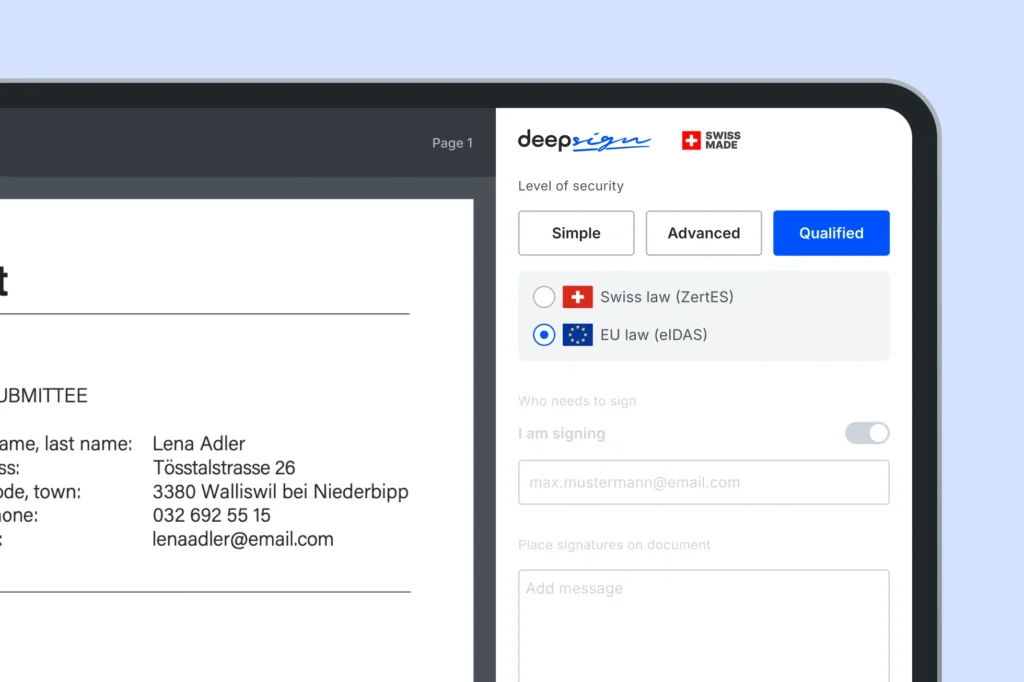
Today, solutions like DeepSign allow both standards to be managed within a single workflow. This means you can choose, case by case, which standard to apply.
In practice:
- for documents governed by Swiss law, a ZertES-compliant QES is used
- for interactions with European counterparties, an eIDAS-compliant QES may be required
This flexibility does not add complexity. It makes the process more adaptable. Users don’t need to switch tools, they simply apply the right level and standard for each situation.
Another key aspect is data management. Swiss-developed solutions place strong emphasis on security and data protection, often relying on infrastructures that meet high standards and ensure data localisation aligned with Swiss and European expectations.
The role of certified providers
To obtain a qualified electronic signature, it is essential to rely on providers recognised under Swiss law, such as DeepSign. These providers ensure that every step of the process meets strict standards, from identity verification to the management of digital certificates.
Their role is fundamental in maintaining the reliability and trustworthiness of the entire ecosystem.
A key building block in digitalisation
Digital signatures are rarely the end goal. More often, they are the starting point of a broader transformation.
When integrated into business processes, they become part of a continuous flow that includes:
- document management
- process automation
- collaboration between teams and partners
It’s within this integration that their real value emerges, evolving from a simple tool into a strategic enabler.
User experience: simplicity that makes the difference
Another factor driving the adoption of electronic signatures is their accessibility. Modern solutions are designed to be intuitive and work seamlessly across devices.
Signing a document becomes a natural action, one that supports the workflow instead of interrupting it.
This simplicity encourages adoption and makes digital signatures effective not only for businesses, but also for clients and partners.
Looking ahead: the role of digital identity
The evolution of electronic signatures in Switzerland is increasingly linked to digital identity. The introduction of the e-ID is set to further simplify identification processes, making access to qualified signatures faster and more seamless.
Looking ahead, signing a document could become an even more immediate action, fully integrated into everyday digital services and platforms.
Conclusion
Digital signatures in Switzerland are much more than a simple alternative to pen and paper. They are a mature solution, supported by a clear regulatory framework and designed to meet the needs of an increasingly digital world.
Their value becomes clear when used thoughtfully: choosing the right level of signature, integrating it into processes, and leveraging its potential to simplify everyday work.
In a context where every interaction matters, the ability to sign documents quickly, securely and with full legal recognition is a tangible advantage. Not just operational, but strategic.